
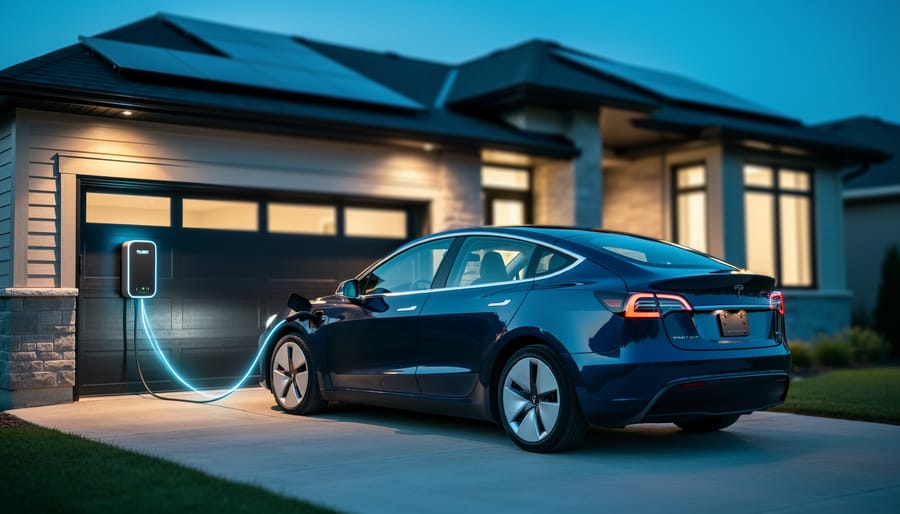
V2H bidirectional charging turns your electric vehicle into a mobile power station that can send electricity back into your home when you need it most. This technology uses specialized equipment to draw stored energy from your EV’s battery during grid outages, peak-demand hours, or whenever your household needs backup power, essentially transforming your car into a large-scale home battery system.
For Ontario homeowners already investing in renewable energy, V2H represents a practical evolution of energy independence. Instead of letting your EV’s 60 to 100 kilowatt-hours of battery capacity sit idle in the driveway, you can tap into that reserve to run essential appliances during blackouts, offset evening electricity costs, or maximize the value of solar energy you’ve generated during the day. The appeal is straightforward: you’ve already purchased the battery on wheels, so why not use it to power your home?
The technology works through a bidirectional charger and compatible vehicle that allows electricity to flow both ways. While standard EV charging only moves power from your home to your car, V2H-capable systems reverse that flow on demand. This capability matters particularly in Ontario’s climate, where ice storms and severe weather can knock out power for extended periods, and where time-of-use electricity rates make strategic energy management financially worthwhile.
This guide explains exactly how V2H bidirectional charging operates, which vehicles and equipment currently support it, how the system integrates with solar installations, and whether it makes practical sense for your home in 2026.
What V2H Bidirectional Charging Means
Vehicle-to-Home (V2H) bidirectional charging turns your electric vehicle into a mobile power source for your home. Instead of electricity flowing only one way, from the grid into your EV’s battery, bidirectional charging allows that stored energy to flow backward, powering lights, appliances, and other electrical loads in your house when you need it.
Most EV owners are familiar with the standard charging setup: you plug your car in overnight, whether through regular outlet charging or a dedicated Level 2 charger, and wake up to a full battery. That’s one-way charging. Your vehicle draws power from the grid, stores it, and uses it exclusively for driving. With V2H technology, that same battery becomes a two-way energy storage system. When the car is parked and plugged into a compatible bidirectional charger, it can discharge stored electricity back into your home’s electrical panel.
- V2H (Vehicle-to-Home)
- Technology that allows an electric vehicle to supply stored battery power directly to a home’s electrical system, rather than just drawing power from the grid.
- Bidirectional Charging
- The ability for electricity to flow in both directions between an EV and an external power source, enabling the vehicle to both charge and discharge energy as needed.
- Inverter
- A device that converts the direct current (DC) electricity stored in an EV battery into alternating current (AC) that powers household appliances and systems.
- DC-to-AC Conversion
- The process of transforming DC power from a battery into the AC power format required by standard home electrical circuits and devices.
Think of your EV as a giant battery on wheels, typically holding 60 to 100 kilowatt-hours of energy, enough to power an average Ontario home for several days during an outage. V2H technology unlocks that potential, transforming your vehicle from just a means of transportation into a flexible home energy asset that works alongside your solar panels or stands alone during emergencies.
How V2H Bidirectional Charging Works
The Role of Solar Integration
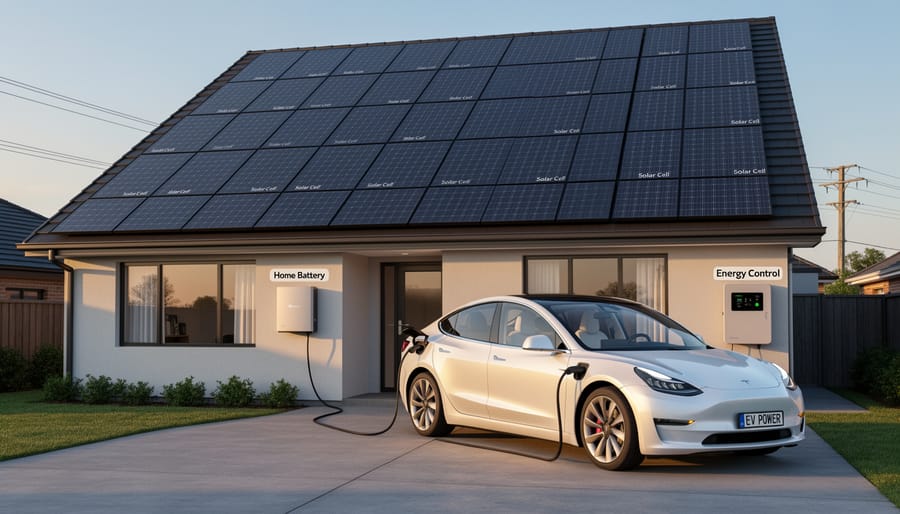
When you pair V2H bidirectional charging with a solar installation, you create a self-sustaining energy loop that maximizes the value of both systems. During daylight hours, your rooftop panels generate electricity that can charge your EV’s battery directly, storing that clean energy for later use. Instead of sending excess solar power back to the grid or letting it go to waste, you’re banking it in your vehicle.
Come evening, when Ontario’s time-of-use rates typically spike and solar production drops to zero, your EV becomes a mobile battery for your home. The bidirectional charger reverses the flow, drawing stored solar energy from your car to power lights, appliances, and heating or cooling systems during those expensive peak hours. This shift cuts your reliance on grid electricity precisely when it costs the most.
The setup also strengthens your resilience during outages. A fully charged EV can supply several days of essential power to your home, all sourced from sunlight you captured yourself. For Ontario homeowners already benefiting from net metering, V2H adds another layer of control, letting you decide when and how to use your solar harvest rather than exporting it at lower compensation rates. Proper installation by certified professionals ensures safer EV charging and seamless integration with your existing solar infrastructure, turning two investments into one cohesive energy strategy.
V2H vs. V2G: Understanding the Difference
The difference between V2H and V2G boils down to where your electric vehicle sends its stored energy. V2H (Vehicle-to-Home) allows your EV to power your house, think of it as a backup battery on wheels that keeps your lights on during an outage or helps offset your electricity bills during peak hours. V2G (Vehicle-to-Grid), on the other hand, lets your car send power back to the utility grid itself, potentially earning you credits or payments for supporting grid stability during high-demand periods.
Both technologies use bidirectional charging, but they serve different purposes and face different practical hurdles. V2H is a closed loop: your car charges from your solar panels or the grid, then discharges into your home when you need it. You control when and how that energy gets used. V2G opens that loop to the broader electricity network, meaning your utility can draw on your EV’s battery to help balance supply and demand across thousands of homes.
For Ontario homeowners in 2026, V2H is the more accessible option right now. The technology is commercially available, and the regulatory path is clearer, you’re simply managing energy within your own property. V2G, while promising, faces more complex regulatory and technical barriers in Ontario. Utilities need to establish programs, pricing structures, and grid integration protocols before most homeowners can participate. Some pilot programs exist, but widespread V2G adoption is still emerging.
This reality means you don’t have to wait for utility approvals to start using your EV as home backup power. V2H systems can be installed today, often alongside your existing solar setup, without navigating the same regulatory maze that V2G requires. Despite common EV charging myths bidirectional charging is a proven technology, it’s the grid integration that takes longer to roll out. For most solar homeowners, V2H delivers immediate, tangible benefits while V2G remains a future possibility worth watching.
Real-World Uses for V2H at Home
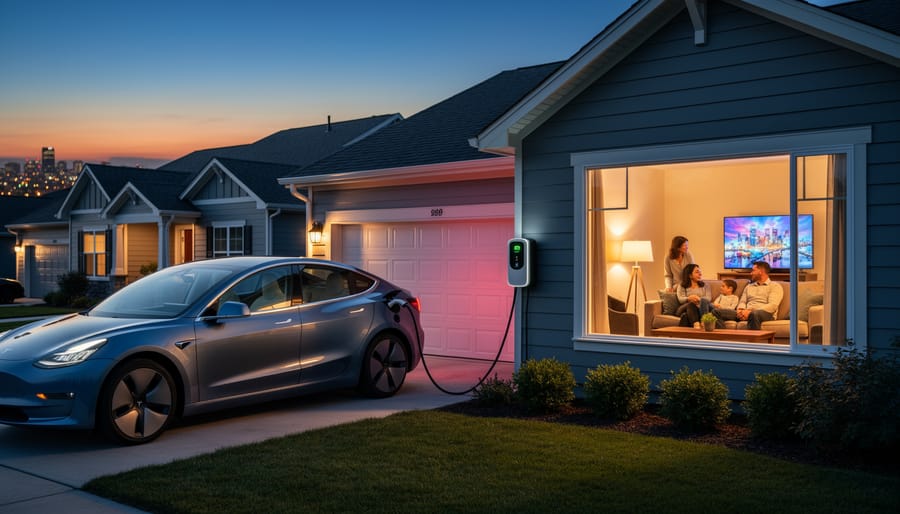
For Ontario homeowners with solar systems, V2H bidirectional charging transforms your electric vehicle from a simple mode of transport into a versatile energy asset. The technology delivers tangible value across several everyday scenarios, each addressing real challenges Ontario households face.
Backup power during outages stands as one of the most compelling benefits. When severe weather knocks out grid power, a growing concern across Ontario, a fully charged EV can power essential circuits in your home for one to three days, depending on your usage and battery capacity. This means your refrigerator keeps running, lights stay on, and critical medical equipment remains powered without a traditional fossil-fuel generator.
Beyond emergencies, V2H helps reduce your monthly electricity bills through peak-shaving. Ontario’s time-of-use rates charge significantly more for power during peak hours (roughly 7 AM to 11 AM and 5 PM to 7 PM on weekdays). You can charge your EV from solar panels during mid-day when the sun is strongest and rates are lowest, then discharge that stored energy back to your home during expensive evening peak periods. This shifts your consumption away from high-cost grid electricity and keeps more money in your pocket.
Here’s how V2H creates value for Ontario solar homeowners:
- Emergency backup during grid outages, powering essential appliances for days
- Time-of-use rate optimization by shifting consumption away from peak pricing periods
- Storing excess solar production that would otherwise go to the grid
- Reducing demand charges for larger homes with high instantaneous power draws
- Extending energy independence and reducing reliance on grid infrastructure
For homes with solar installations, V2H closes a critical gap. Your panels generate abundant power at midday when you’re at work and consumption is low, but your highest usage comes in the evening after sunset. V2H lets you capture that midday solar surplus in your EV battery, then release it precisely when your household needs it most. You consume more of the clean energy you generate rather than sending it back to the grid at wholesale rates and buying it back later at retail prices.
Emergency preparedness takes on new meaning with V2H. During prolonged outages caused by ice storms or summer storms, you’re not scrambling for fuel or rationing generator runtime. Your EV becomes a silent, emissions-free backup system ready whenever the grid fails.
Compatible EVs and Equipment for 2026
As of 2026, the list of vehicles with genuine V2H capability remains selective, though it’s growing faster than in previous years. Manufacturers like Ford, Hyundai, Kia, and Nissan have models equipped with bidirectional charging hardware, but not every trim level or battery configuration supports the feature. Some automakers enable V2H through software updates, while others require factory-installed hardware from the start.
When shopping for a compatible EV, confirm bidirectional support directly with the dealer and ask whether it requires specific packages or upgrades. Marketing materials sometimes blur the line between theoretical capability and real-world availability, so get written confirmation before committing.
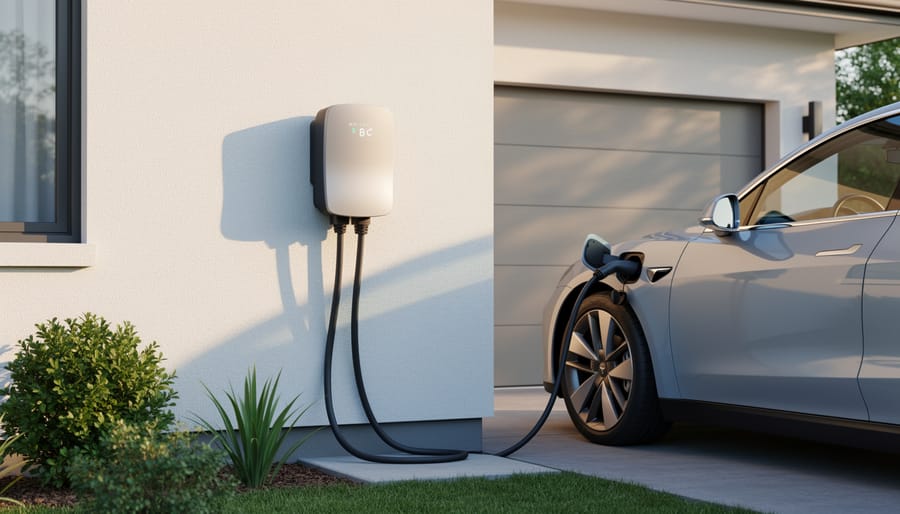
On the equipment side, you’ll need a bidirectional charger certified for home use in Ontario. These units differ from standard home charging options because they manage two-way power flow, converting DC battery power to AC for your home’s electrical panel. Look for chargers approved by the Canadian Standards Association and compatible with your utility’s interconnection requirements.
Key features to evaluate include maximum power output (measured in kilowatts), integration with home energy management systems, and whether the unit supports solar pairing. Some chargers include smart controls that automatically shift between charging your vehicle, powering your home, and optimizing solar energy use based on time-of-use rates.
Because compatibility depends on your specific vehicle model, electrical panel capacity, and existing solar setup, work with a certified installer who can assess your system. They’ll verify that your chosen EV and charger work together, handle permitting, and ensure safe integration with your home’s electrical infrastructure. The technology is maturing quickly, so what’s available today will likely expand significantly over the next few years.
Is V2H Right for Your Ontario Solar Home?
V2H bidirectional charging isn’t a one-size-fits-all solution. Whether it makes financial and practical sense for your Ontario home depends on your specific energy profile and circumstances.
Start by looking at your existing solar system. If you have a robust installation, say, 8 kW or larger, you’re already generating substantial daytime power that often goes to the grid under net metering. V2H lets you capture that excess in your EV battery and use it during evening hours when your panels aren’t producing. Smaller systems can still benefit, but the payback calculation shifts.
Your typical power usage matters just as much. Households with high evening consumption, especially during peak rate periods under Ontario’s time-of-use pricing, stand to save more. If you’re running air conditioning, electric heating, or charging multiple devices after 7 PM, shifting to stored solar power cuts into those expensive peak charges. Conversely, if your usage is modest and spread throughout the day, the savings shrink.
Outage frequency in your area is another critical factor. Rural Ontario homeowners who lose power several times a year gain real value from backup capability. Urban residents with stable grid service might prioritize cost savings over resilience.
Then there’s the upfront investment. Bidirectional chargers and installation typically cost more than standard Level 2 units. You’ll need to weigh that against potential savings on electricity bills, reduced reliance on the grid, and the intangible benefit of energy independence. Payback periods vary widely, anywhere from five to fifteen years depending on usage patterns and electricity rates.
Don’t evaluate this in isolation. A certified local installer can model your specific situation, factoring in your solar production data, historical consumption, local utility rates, and available incentives. They’ll provide a realistic cost-benefit analysis rather than generic projections. Reach out for a personalized assessment before committing to V2H technology.
Common Questions About V2H Bidirectional Charging
Homeowners considering V2H bidirectional charging naturally have questions about how it affects their vehicle, their home’s power supply, and the installation process. Here are answers to the most common concerns.
Does V2H wear out my EV battery faster?
Modern EV batteries are designed to handle thousands of charge cycles, and V2H systems include battery management features that minimize additional wear. Most manufacturers report that typical V2H use adds minimal degradation compared to normal driving and charging patterns.
How much of my home can V2H power?
This depends on your EV’s battery capacity and your home’s energy needs. A typical EV with a 60-80 kWh battery can power essential circuits for several days or run a whole home for 12-24 hours during an outage, assuming average usage.
What happens during a grid outage?
When properly configured with transfer equipment, your V2H system automatically disconnects from the grid and switches to backup mode, using your EV’s stored energy to power your home. This happens seamlessly, much like a traditional backup generator.
Can I still drive my car when using V2H?
Absolutely. You control how much charge stays reserved for driving through your system settings, ensuring you always have the range you need while still providing backup power to your home.
Understanding why a proper charger matters is crucial because V2H requires specialized bidirectional equipment that handles power flow in both directions safely. Standard Level 2 chargers won’t work for this application.
Regarding net metering in Ontario, V2H operates independently of net metering programs. Your solar system can still send excess power to the grid under net metering rules, while your V2H setup manages power between your EV and home separately. These systems work together rather than conflicting.
Installation timelines typically range from four to eight weeks in Ontario, accounting for equipment ordering, permit approval from your local utility and municipal authorities, and the actual installation work. Your installer will handle the permitting process, which includes electrical safety inspections and utility interconnection agreements. Working with certified local installers familiar with Ontario regulations ensures compliance and proper integration with your existing solar system.
V2H bidirectional charging represents a meaningful step forward for Ontario homeowners who’ve invested in solar energy. By turning your electric vehicle into a mobile power reserve, this technology strengthens your home’s energy independence, reduces reliance on grid electricity during expensive peak hours, and provides genuine peace of mind when outages strike.
The potential extends beyond individual convenience. As more households adopt V2H systems, we’re collectively building a more resilient, decentralized energy network, one that makes better use of renewable power and reduces strain on aging infrastructure. For solar homeowners especially, V2H closes the loop: your panels charge your car, your car powers your home, and you maximize every kilowatt-hour you generate.
Whether V2H makes sense for your specific situation depends on your energy patterns, solar system capacity, and local grid reliability. That’s why we encourage you to connect with certified installers who understand Ontario’s unique energy landscape and regulatory environment. CANBIO works with trusted local experts who can assess your home, answer detailed questions, and design a system tailored to your needs. Explore what’s possible, this technology is here now, and it’s evolving quickly.
Leave a Reply